
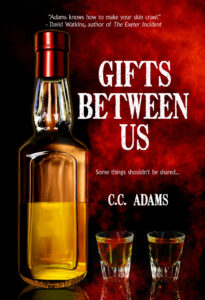
 Author: C.C. Adams
Title: Gifts Between Us
Published On: 9/8/25
Publisher: French Press Publishing Pages: 92
Genres: Horror
Format: eBook, Paperback
My Rating:
I received this book for free from Publisher in exchange for an honest review. This does not affect my opinion of the book or the content of my review.
Source: PublisherPurchase Links:


Elderly Londoner Augustus has lived a long, miserable life. Having driven his few remaining loved ones away years ago, he now whiles away his time drinking rum and hoping for the end.
One night his death wish is nearly granted by a mugger, but a local youth called Michael intervenes. Much to the old man’s horror (and fascination) Michael promptly begins to devour the mugger’s body.
Slowly, Augustus and his mysterious saviour form an unlikely friendship, one built on sharing the gifts of trust, camaraderie, and acceptance.
And one last gift: a secret. It is the cause of Michael’s cannibalistic nature. And, perhaps, a reason for Augustus to go on living…
My Review of Gifts Between Us
Gifts Between Us is a quick, gripping read with vivid writing and a darkly fascinating twist. Watching Augustus and Michael’s unlikely friendship grow is both eerie and oddly heartwarming. Horror fans will love the tension, mystery, and chilling surprises—definitely worth a read!
Interview with C.C. Adams
What inspired you to write this book, and where did the initial idea come from?
This came from one of author Brian Keene’s posts on Twitter a few years back. He’d tweeted a picture which had inspired the idea for one of the characters in the novella– the last one you meet, in fact. The other main aspect was to do more of a stripped-back narrative, with a very small cast of characters.
I’d actually written this in a fortnight just before Christmas 2020. My friend Terri (who I love to bits) only had a brief window of opportunity to beta-read the story. Luckily, come early December that year, I pretty much had the idea and character dynamics down cold. All I had to do was write at breakneck speed to get the draft down, do
basic clean-up and then send it to her for feedback. Business as usual.
How did you develop your characters—did any of them surprise you as you were writing?
Not surprise, no. As for developing those characters? There’s a degree of borrowing from real life; people that I’ve encountered. What had been more rewarding is with a very minimalist cast, it allowed room to truly explore those dynamics between the characters.
Which character was the most fun (or the most difficult) for you to write, and why?
The last character you’re introduced to was probably the most fun to write. And here’s the thing: for my close friends and go-to beta readers, they already have an idea of what I’m capable of, what kind of story I’m going to bring to the table. That said, I want to not only engage them and maybe wow them, but catch them off- guard, you know? Like, you know what kind of stories I write, but you won’t expect exactly what I set in front of you. Nor will you suss where it’s headed, either.
Can you walk us through your writing process? Are you a planner, a pantser, or somewhere in between?
Oh, I’m definitely a planner. Even on a basic level, it doesn’t matter whether it’s a short story or a full-blown novel: I always want to have the elevator pitch and the
ending in mind.
The first thing I need to lock down is the title, even going so far as to search the likes of Twitter to make sure it doesn’t exist already. Rarely do I pick a title that’s
…commonplace, but once the title is locked in, the next thing is the epigraph. Having watched things like the pilot film for The Incredible Hulk’s live-action TV series way back when, I loved the epigraph/title card for that. “Within each of us, ofttimes, there dwells a mighty and raging fury.” I just love that there is a quote or a saying that can pique the interest and set the stage for what’s to come. And the same way I can spend hours looking for just the right title, I spend hours looking for the opening quote.
Once I have that, I’ll do basic outlining and research, to capture character beats, research locations, etc. My stories are usually set in London and despite being a
native, I still need to do more homework and make sure that those settings are captured realistically; the look, sound and smell of it all has to be on point. The more realistic it is, the more immersive it is; and it’s a point of personal pride that I bring you such vivid representations of the capital, from the viewpoint of all these characters. Hell, given how London is, I try and capture that as a character. The size of it, the physical landscape, the diversity in the population, the scenery, the languages, the music, the food, the entertainment, the politics, you name it. It’s such a rich and vast tapestry, so I need to bring that to life in my work.
What themes or messages do you hope readers take away from your story?
Honestly, there isn’t any particular theme or message that I want readers to take away from this one. I’ve had people read my work and see romantic relationships
where there are none. Or see religious overtones where there are none – certainly not intended, anyway.
But what I do hope readers find in the story is something that engages them, wows them, and maybe even scares the shit outta them. And this, again, is a point of
personal pride. You can argue that this is splitting hairs, but I never want to just write a story when I can craft one. And, as such, I’ll craft something with the deliberate
intention of unsettling you; disturbing you. So, if my work lingers with you after you’ve closed the book, or a scene come back to haunt you; even if you feel the need to re-read it to catch a detail I guided you past the first time? That’s all deliberate.
Was there a particular scene or moment in the book that was especially meaningful to you as an author?
I’ve witnessed a scene similar to one in the first chapter, so there’s that.
What challenges did you face while writing this book, and how did you overcome
them?
In terms of writing the book, I guess one challenge was knocking out a finished draft inside of two weeks once I had the idea. Two weeks to make sure that my friend Terri could give it a critique and then get back to enjoying her Christmas. Out of all the work I’ve written, this is one of the more notable pieces because it really did flow onto the page. Once I had the elevator pitch and the ending and I’d done the basic outline, research and character beats, it damn near wrote itself. The real challenge was finding a publisher that would take it on – even by novella standards, it’s light at a little over 20,000 words. But in much the same way that you wouldn’t shop just anywhere or bank just anywhere, so it is with where you would have your work published: you want to find a publisher that’s a good fit.
What authors or books have influenced your writing style the most?
If I had to pick one, it would be Michael Crichton. Works like Jurassic Park, Timeline and Prey are my favourites, and this is where I’d cite Timeline in particular. Because he’d weave fact and fiction into a near-seamless work of action, intrigue, drama and suspense.
What that had impressed upon me was the importance of doing your homework. Most of my work is set in and around London (so far, there are only two exceptions
published that aren’t). While I’m born and raised in the capital and take pride in a love and knowledge of it, I don’t know absolutely everything about it. So, this is
where I’m going to be meticulous. I may spend hours researching a location on Google Maps from different angles, or visit that location in person to take pictures and video footage. Spend time online scouring newspaper articles, or visit libraries to use their archives for research. It’s that important – and hopefully, it helps bring realism, nuance and life to the stories I tell.
If readers love this book, what should they expect next from you?
Something set in the capital, focusing on different characters and scenarios, but still nudging those everyday narratives to dark and insidious places.
What advice would you give to aspiring writers who want to tell their own stories?
Write. And it sounds like such a cliché, but this is where I’ll qualify it. Because the more you write is the more you practice, elevate and hone your craft. It’s also how
you attract and keep the attention of an audience, whether that’s readers, fellow authors, publishers, etc. It’s easy to buy into someone and what they bring to the table if they’re constantly putting in work and delivering the goods. Go be that someone.